
About Capital Benchmark

Independent research for the next generation of corporate credit.

Capital Benchmark is an independent research and advisory initiative focused on how AI can be deployed safely and effectively in corporate credit. Our work combines rigorous benchmarking with executable reference implementations so that institutions can evaluate what current AI systems can do — and what it takes to make them reliable enough for real credit processes.

Experience

Three decades working with banks

Capital Benchmark is led by Barrie Wilkinson, who has around 30 years of consulting experience in banking and financial services, including 20 years as a partner at Oliver Wyman.

His work has focused on bank risk, credit, portfolio management and the practical implementation of analytical tools inside large financial institutions. In the 1990s he was part of a generation helping banks introduce automated credit rating and decision-support systems — an earlier wave of technology-driven change in credit.

Large language models create the possibility of moving the automation boundary again — from structured scoring into the analysis, policy interpretation and prose that still sit at the heart of complex credit decisions.
Research agenda

Testing reliability, not just fluent prose

Our initial research programme focuses on AI-enabled corporate credit analysis: credit memo generation, policy interpretation and credit decision support.

The benchmark compares leading large language models against common obligor data, illustrative facility requests and a consistent credit-policy framework. The objective is to test whether a system can reproduce the reasoning, discipline and decision consistency required in a real credit process.

The research is supported by an executable reference platform built using public and illustrative data, allowing model behaviour to be examined without requiring confidential bank information.

Business model exhibit

How the Capital Benchmark model works

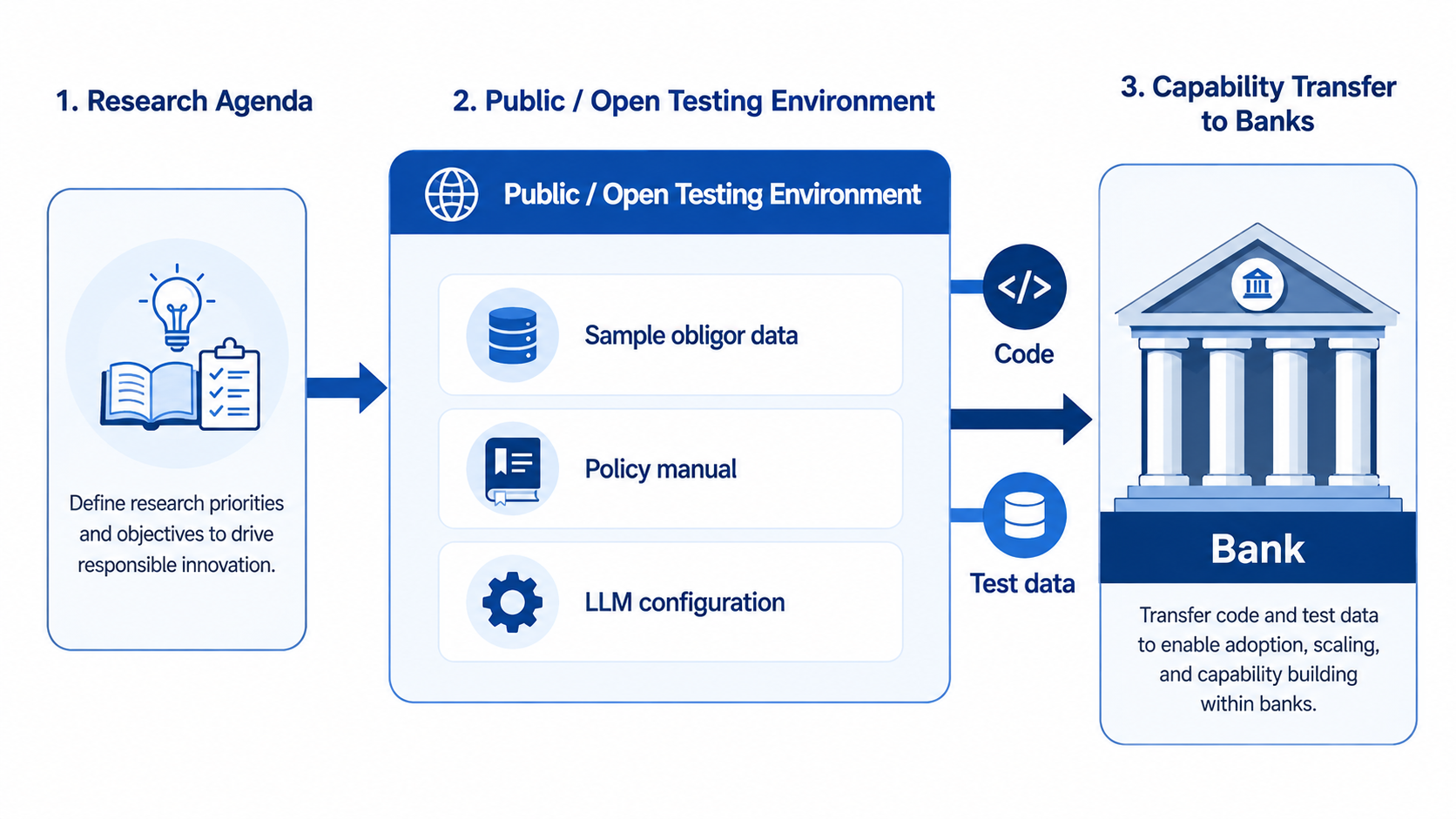
The business model starts with an independent research agenda, converts that agenda into a public testing environment, and then transfers validated code and test assets into bank-controlled pilots.

Research agenda → testing environment → capability transfer
Capital Benchmark business model exhibit showing research agenda flowing into a public testing environment and capability transfer to banks.
Suggested asset path: static/business_model_exhibit.png. Save the generated exhibit to your Flask static folder and the About page will render it automatically.
1Research agenda

We identify the policy questions, edge cases, model providers and operational issues that credit-risk teams actually care about. This ensures the work remains grounded in domain knowledge rather than generic AI claims.

2Public / open testing environment

We use sample obligor data, an illustrative policy manual and explicit LLM configurations to test ideas in a non-client environment. That gives banks a safe way to inspect results before any integration with internal data or systems is considered.

3Capability transfer to banks

The output of the research is not just a report. It is working code, test data and a validated methodology that can be transferred into a bank-specific pilot so internal teams can develop their own implementation.

What comes next

Building the evidence base through 2027

The current benchmark is the starting point for a broader programme covering provider configuration, implementation effort and institution-level deployment.

2026

Publish the benchmark research

Complete and publish the first Capital Benchmark research on AI-enabled corporate credit analysis.

Next research phase

Deepen provider-agnostic testing

Measure the engineering effort, configuration, cost and latency required to reach an agreed reliability threshold across providers.

2027

Institutional reference deployments

Work with participating banks and credit institutions using the reference platform as a common testing and implementation framework.

2027+

Cross-bank benchmarking

Build an anonymised view of AI adoption, performance and implementation practices across participating institutions.